


OZ Biosciences offers solutions to improve your transfection for Neuroscience Applications.
Magnetofection for Neurosciences
Magnetofection™ technology has proved to be one of the most efficient and non-toxic gene delivery system and can overcome the challenges of neurons transfection. The magnetic nanoparticle and nucleic acid complexes are iinternalized by cells thanks to a magnetic field, therefore lowering the required dose of nuclic acid.
magnetofection advantages over other transfection methods
Common issue encountered with transfection applied to Neurosciences
- High Toxicity.
- Need for expensive material or specialized equipments.
- Technically challenging.
- Low transfection efficiency.
How Magnetofection can solve it
- The gene vector and nanobead complex will be retained at the target site thanks to a magnetic force allowing a specific transfection/infection.
- Nucleic acid or virus doses needed are reduced, making it a non-toxic process.
- The magnetic force will enhance the uptake of the magnetic particle complex by the target tissue, which reduces the process time of delivery.
- Cells can be transfected at any stage of differenciation.
Magnetofection products dedicated for Neuroscience Applications
NeuroMag
NeuroMag is the first dedicated transfection reagent for primary neurons and neural cells. Due to its unique properties, NeuroMag allows to follow the maturation of transfected neurons during several days after transfection.
Key features:
- Versatile: can transfect any kind of brain cells and other types of primary neurons from various origins and territories with different nucleic acid types (DNA, siRNA, ODN, LNA …).
- Efficient from 0 DIV to 21 DIV.
- Great efficiency, low toxicity.
- Can also be used in vivo.
Example of neural cell types transfected with NeuroMag
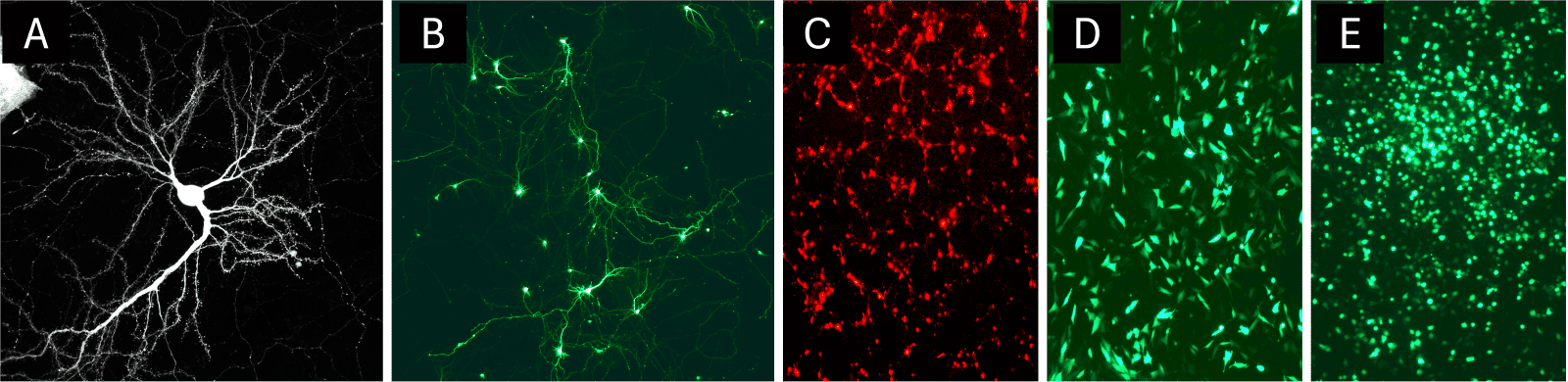
Figure 1: NeuroMag can adress various neuronal cell types such as primary mouse neurons at DIV 20 (a), primary rat hippocampal neurons (b), neural stem cells (c), embryonic mouse hypothalamus cell line (d) or microglia cells (e).
Further reading: A comprehensive analysis of magnetofection-mediated gene delivery in mature primary neurons. We examine neuron transfection efficiency, viability preservation and long-term expression in differentiated cultures. Read the white paper
GlialMag
Glial-Mag transfection reagent is a new powerful formulation for delivery of nucleic acids into microglial cell lines and primary microglia.
Glial-Mag kit is the association of a specific magnetic nanoparticles formulation (Glial-Mag reagent), issued from our Magnetofection™ technology and a booster (Glial-Boost) that enhances efficiency.
Key features:
- Highly efficient with microglial cell lines & primary cells (such as BV2, N9, N13, HMO6, MG-5, SIM-A9).
- Low nucleic acid amount - minimized toxicity.
- High level of nucleic acid compaction.
- Easy and straightforward protocol.
- Compatible with any culture medium.
Transfection of BV2 using GlialMag compared to competitors:
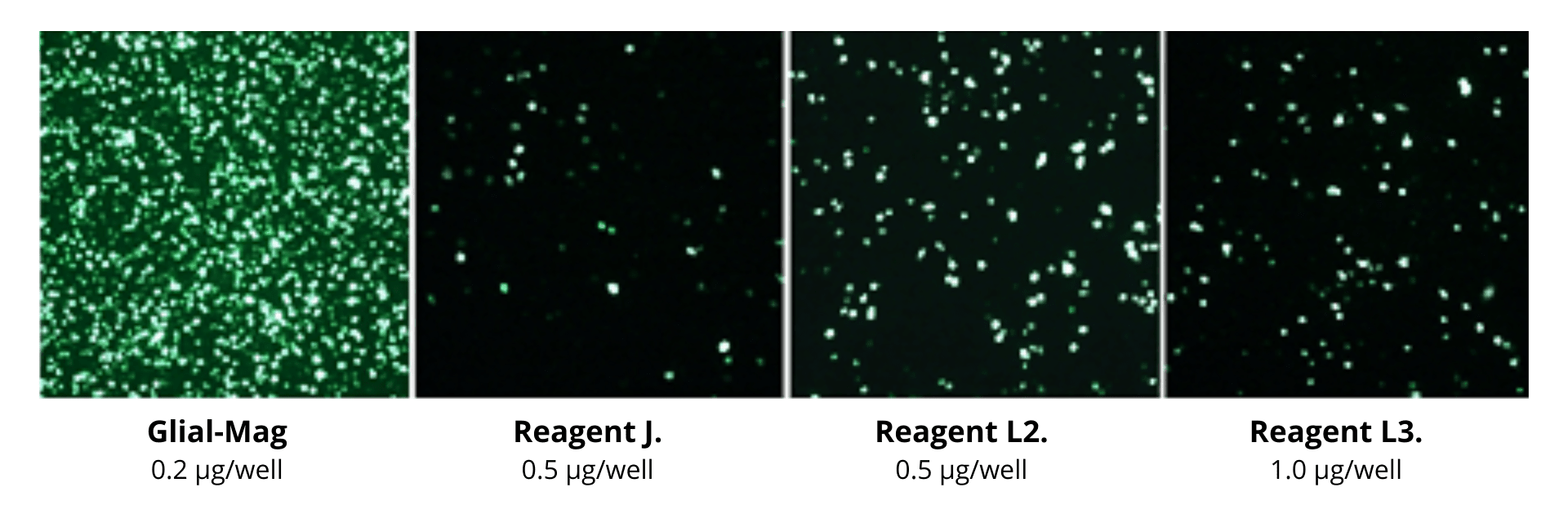
Figure 4: Transfection of BV2. Complexes of pVectOZ-GFP encoding DNA and Glial-Mag were prepared as described in the standard protocol. Other commercial transfection reagents were used as recommended by the manufacturers. After 24h, GFP+ cells were analysed by fluorescence microscopy.
Explore our Webinar on Magnetofection for Neurosciences
Discover the principles, methods, and real-world applications of Magnetofection in neurosciences. Learn about the challenges and advantages of magnetofection, and discover how our product, Neuromag, can enhance transfection efficiency in neurons.
WatchPolymer-based reagent for in vivo Transfection in Neurosciences
BrainFectIN™
Major difficulties with gene delivery in the central nervous sytem is the weakness of standard non-viral gene carriers and the limitations associated to the use of viral particles (time-consuming and requires additional safety precautions).
Unlike these methods, BrainFectIN™, an original non-viral formulation, enables safe, easy and efficient nucleic acids delivery into central nervous system of small animal.
Key features:
- Polymer-based reagent.
- Adapted for in vivo transfection into CNS of small animals.
- Reduces inflammation and high diffusion.
- Low DNA required amount.
- High efficiency.
- Low toxicity.
- Long-term transgene expression.
Stereotaxic injection of BrainFectIN/DNA complexes in hippocampus induced an efficient transfection rate of neural cells in all areas of hippocampus:
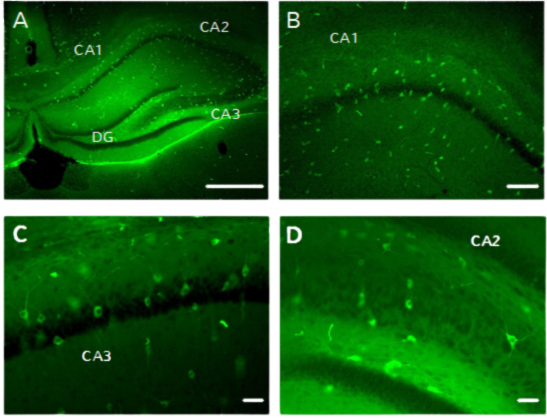
Figure 5: GFP expression in hippocampus of rat (p11) 48h after BrainFectIN/pGFP injection (ratio 1:1.5) shows an efficient transfection rate of neural cells in all areas of hippocampus.
Trusted by scientists and validated by thousands of publications in high-impact journals.
Explore Citation Database







Discover our other applications

3D Transfection
Three-dimensional (3D) matrices, such as 3D-scaffolds and 3D-hydrogels, work as mechanical platforms for cell attachment and growth.

Stem workflow
Stem cells are widely investigated due to their regenerative potential. In many cases, it would prove useful to enhance or reduce some of their features through gene delivery strategies...

In vivo Magnetofection™
In vivo Magnetofection™ has been designed for in vivo targeted transfection and infection. This original system combines magnetic nanoparticles and nucleic acid vectors...