



BLOG > Publications & Citations > How Magnetofection unlocks high-efficiency CRISPR Genome Editing
Paper from: Go I, Lee SH. Highly efficient CRISPR editing enabled by magnetic nanoparticle delivery. Front Genome Ed. 2026 Jul 27;8:1865675.
A controlled, head-to-head benchmark of PolyMag Neo magnetofection against lipofection across Cas9, Cas12, prime editing and RNP delivery.
Executive summary
The performance ceiling of CRISPR genome editing is set less by the nuclease than by how efficiently the editing machinery reaches the nucleus. In a rigorously controlled benchmak done by Go I et al in Front Genome Ed., 2026, Magnetofection with PolyMag Neo was compared head-to-head against Lipofectamine 3000 under identical cellular and vector conditions, with the delivery reagent as the only variable. Across every modality tested, magnetofection was the decisive winner (Table 1).
| Editing modality | Lipofection | Magnetofection | Fold gain |
| SpCas9 (indel) | 12.5% | 42.3% | 3.4x |
| AsCas12a (indel) | 8.1% | 45.0% | 5.6x |
| Prime editing | 3.8% | 14.0% | 3.7x |
| RNP (Cas9:gRNA 1:4) | 0.19% | 1.56% | 8.3x |
| Cell viability | Moderate | High |
Table 1. Editing efficiency of magnetofection versus lipofection across four CRISPR modalities in HEK293FT cells. Mean editing rates obtained with PolyMAG Neo magnetofection and with Lipofectamine 3000, under identical cellular and vector conditions with the delivery reagent as the only variable. Indel values are averaged across multiple genomic loci; prime editing across five loci; RNP delivery at a Cas9:gRNA molar ratio of 1:4. Fold gain is the ratio of magnetofection to lipofection.These gains were reproducible across ten genomic loci and multiple adherent cell lines, and were achieved without any loss of editing fidelity or cell viability. The pattern points to a single, actionable conclusion: optimizing delivery alone can transform editing outcomes.
“magnetic nanoparticle-mediated delivery enables highly efficient and reproducible CRISPR genome editing, substantially outperforming conventional lipofection for both indel formation and prime editing.” Go & Lee, Front. Genome Ed. 2026 (CC BY).
The delivery bottleneck
A successful edit is the product of three factors: nuclease activity, guide design, and intracellular delivery. The first two are now largely mature. Delivery is the variable that still governs whether a well-designed experiment yields 5% or 45% editing. The gap is widest for most valuable modalities. Base editing, prime editing and ribonucleoprotein (RNP) approaches all require the coordinated delivery of several bulky, highly charged components at once, so their output is exquisitely sensitive to delivery efficiency.
Conventional options carry a cost. Lipofection is simple and hardware-free, but its efficiency is cell-type dependent and frequently modest. Electroporation reaches high efficiency, yet demands specialized instrumentation and subjects cells to harsh electrical pulses. Magnetofection occupies the practical good spot : simplicity of a reagent added to standard culture with an efficiency profile far more invasive methods.
How Magnetofection works
Magnetofection replaces the random, diffusion-limited encounter that governs lipofection with a directed magnetically driven delivery step. The protocol is simple yet effective and transfection that occurs at the plasma membrane is driven by physical forces.
General protocol
The editing cargo, whether plasmid DNA, mRNA or preassembled Cas9 ribonucleoprotein (RNP), is first mixed with PolyMag Neo magnetic nanoparticles. These are iron-oxide cores carrying a cationic polymer coating, so the negatively charged cargo binds electrostatically to the particle surface. Complexes are then formed during a 20 min incubation period at room temperature (RT). The prerequisite here is that the medium used is free of supplement, such as serum, antibiotics or growth factors.
The complexes are then added directly to the cells in standard culture medium, and the plate is placed onto a magnetic plate (such as the Super or the Mega Magnetic Plate). The magnetic field draws the complexes down onto the cell layer within minutes ; the plate is then removed, and the cells return to normal culture until evaluation of the experiment 48 to 72H later. No supplementary material or medium change is required, and the same workflow serves DNA, RNA or RNP without modification (Figure 1).
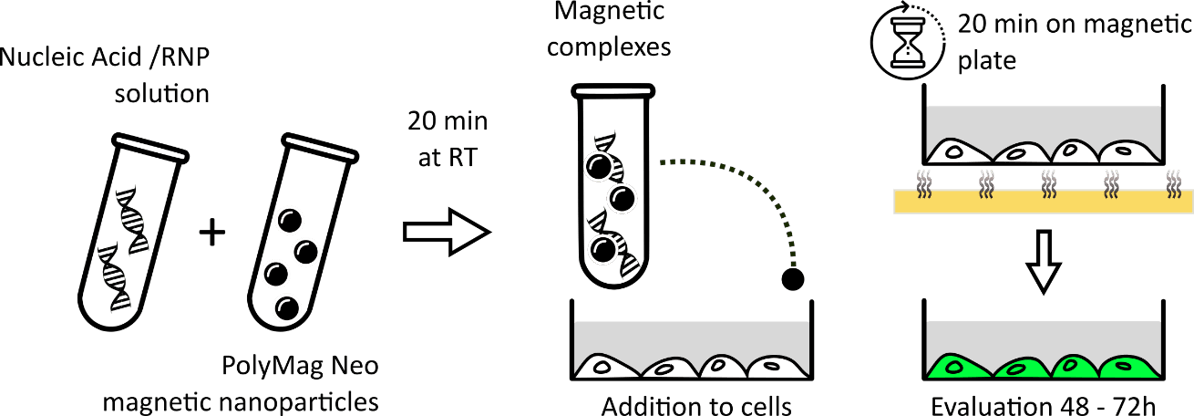
Figure 1: PolyMag Neo Magnetofection workflow, from complex formation to editing readout 48 to 72H later.
What happens at the plasma membrane
Lipofection and Magnetofection get the cargo to the cell in fundamentally different ways (Figure 2): the first by passive diffusion, the second by actively driven, magnetic step.
Under lipofection, the reagent complexes the negatively charged cargo into cationic lipoplexes, which are designed to associate with the cell surface. The limiting step is therefore not attachment but how the complexes reach the cell surface only slowly and passively, by sedimentation and diffusion. Since no force is driving them to the membrane, the effective contact stays low and strongly dose-dependent: only a small fraction of the applied cargo is ever internalized, and efficiency falls further with cargo size, type of cell…To compensate, the input must be scaled up: more cargo and a higher volume of transfection reagent are needed to drive adequate amount across the membrane, with the direct corollary of increased reagent cost and moreover cellular toxicity.
Magnetofection changes the physics of this step. The magnetic field imposes a directed force on every complex, actively drawing them onto the cell layer instead of leaving them to sediment passively. This raises the local cargo concentration at the membrane far above what passively delivery could achieve, and the increased frequency and duration of membrane contact promote internalization through endocytic uptake; cationic polymer coatings are additionally thought to assist escape from the endosome once inside. At this point, no hole is created in the membrane as opposed to other physical methods of transfection resulting in a low toxicity associated to an efficient delivery even at low cargo dose. Moreover, in the case of this article, Magnetofection drives increased editing capacities.
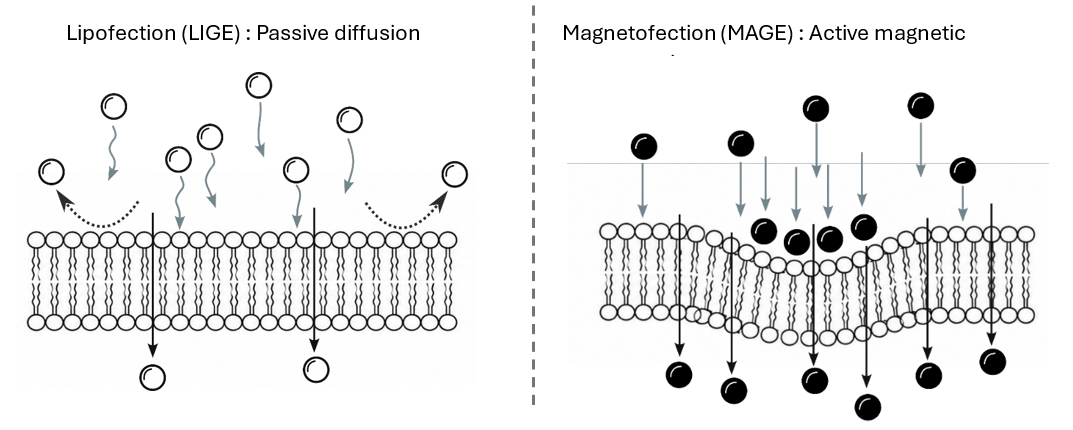
Figure 2. Passive diffusion versus active magnetic delivery. With lipofection (LIGE, left), cargo approaches the membrane only by random passive diffusion: many components drift away or fail to cross, so few reach the cytoplasm. With Magnetofection (MAGE, right), PolyMag Neo-bound cargo is dirven undirectionally toward the membrane by an external magnetic field, concentrating editing components at the bilayer and markedly increasing the fraction that is internalized. This physical enrichment boosts cellular uptake even at low cargo input, and underlies the higher editing efficiencies reported throughout this study.
Study Overview
- Cells: HEK293FT as the primary model with HeLa and the CuFi cystic-fibrosis disease line confirming reproducibility across adherent contexts.
- Targets: ten endogenous loci (AAVS1, DNMT1, EMX1, FANCF, HBB, RUNX1, HEK4, PRNP, POR, HEXA).
- Design: identical cells, CRISPR vectors and cargo amounts; the delivery reagent was the single variable: PolyMag Neo vs Lipofectamine 3000.
- Readout: targeted deep sequencing (NGS) at 48 h, three independent biological replicates, two-way ANOVA.
Results
To test whether the benefit is general rather than specific to one system, Magnetofection with PolyMag Neo was benchmarked across four editing modalities of increasing delivery demand: the standard nucleases SpCas9 and AsCas12a which create indels; prime editing, which installs precise edits from three separate components; and preassembled Cas9 ribonucleoprotein (RNP).
Nuclease-independent indel gains. In HEK293FT cells, magnetofection increased the average transfection rates from 12.5% to 42.3% for spCas9 and from 8.1% to 45.0% for AsCas12a. The fact that two different nucleases reach a similar ceiling is revealing in itself: the advantage lies in the method of delivery and is not a characteristic specific to any one enzyme (Figure 3).
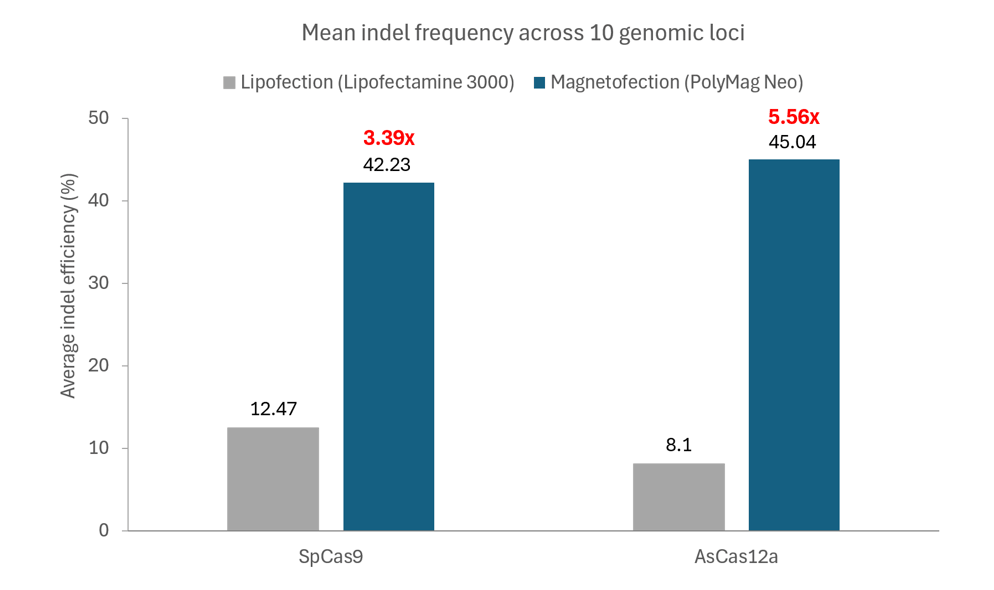
Figure 3. Indel efficiency in HEK293FT cells. Mean indel frequencies induced by SpCas9 and AsCas12a, delivered by lipofection or magnetofection and averaged across ten genomic loci. Magnetofection raised editing 3.4-fold for SpCas9 and 5.6-fold for AsCas12a. Quantified by NGS 48 h after transfection.
Prime editing. It is very demanding in terms of delivery, as the editor, the RNA and the nick guide must all arrive simultaneously. Magnetofection has made it possible to increase the precise editing rate from 3.8% to 14.0% (a 3.7-fold increase) without increasing the number of unwanted indels, representing a net gain in one of the most challenging modalities to implement (Figure 4).
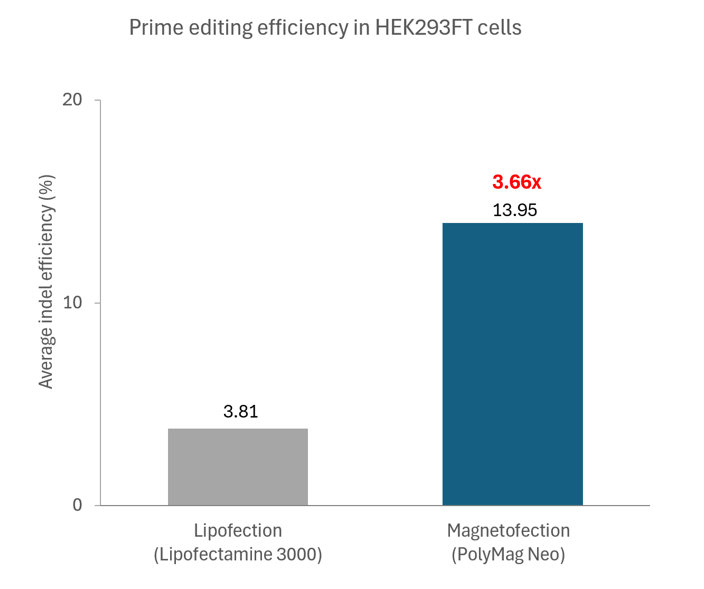
Figure 4. Prime editing efficiency in HEK293FT cells. Precise editing by the prime editor (pegRNA plus nicking guide), delivered by lipofection or magnetofection and averaged across five loci (FANCF, RUNX1, HEXA, EMX1, POR). Magnetofection increased efficiency 3.7-fold, from 3.8% to 14.0%, without raising unintended indels.
One reagent, every modality. For preassembled Cas9-gRNA complexes at limiting stoichiometry (1:4), magnetofection produced 1.56% indels versus 0.19% for lipofection, an 8.3x improvement, while indel mutation spectra were unchanged, indicating delivery is enhanced without altering DNA-repair outcomes (Figure 5).
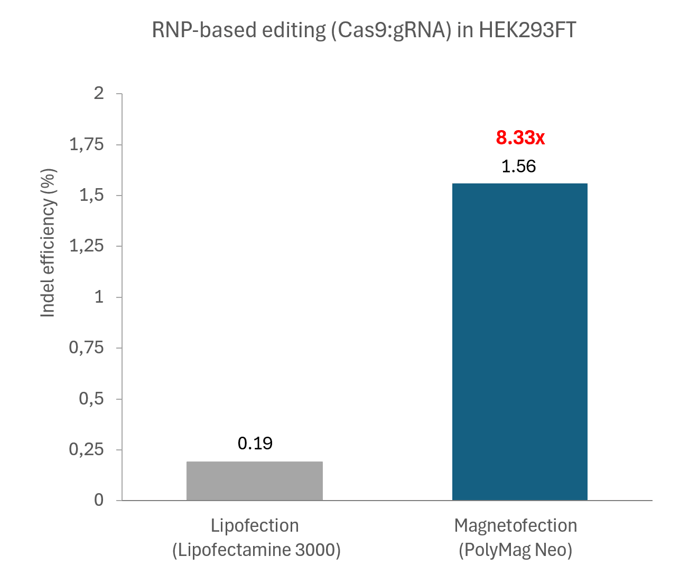
Figure 5. RNP-based editing in HEK293FT cells. Indels from preassembled Cas9-gRNA ribonucleoprotein at a 1:4 molar ratio, delivered by lipofection or magnetofection. Magnetofection yielded 1.56% versus 0.19% indels, an 8.3-fold gain, with unchanged mutation spectra.
Consolidated across formats, the direction of the results never changes: PolyMag Neo outperforms lipofection with Lipofectamine by 3.4x to 8.3x (Figure 6).
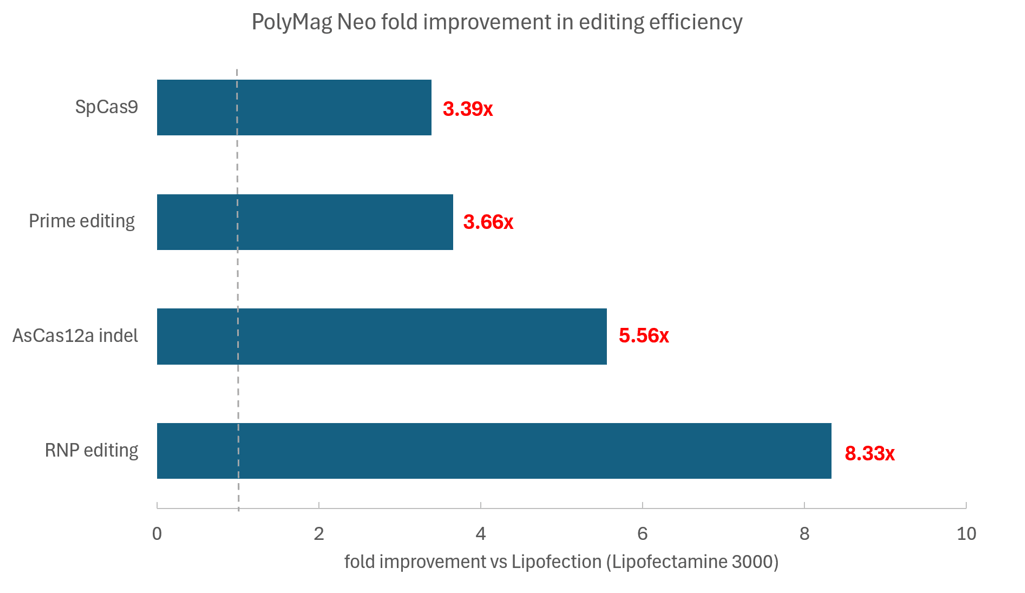
Figure 6. Fold-improvement across modalities. Ratio of magnetofection to lipofection editing efficiency for each modality in HEK293FT cells. The gain is largest where delivery is most limiting, reaching 8.3-fold for RNP.
Delivery, viability and specificity. Beyond editing rates, the study also looked at delivery, viability and specificity. A GFP reporter gave about five-fold higher total fluorescence with Magnetofection than with lipofection, confirming that more cargo actually reaches the cells (Figure 7). Cell viability, measured by trypan blue exclusion, stayed high and was comparable between the two methods.
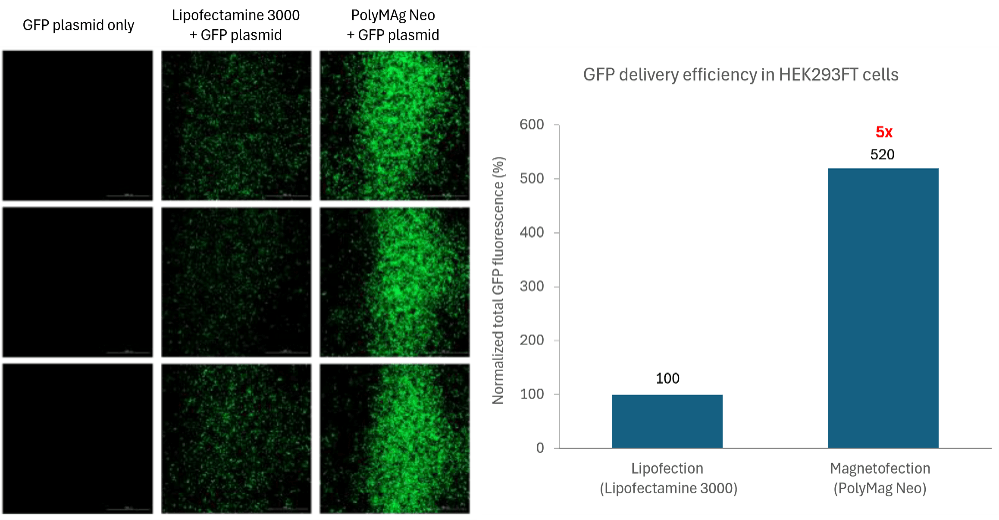
Figure 7. Magnetofection with PolyMag Neo delivers more cargo into cells. GFP fluorescence in HEK293FT cells 48 h after delivery of a GFP-expressing CRISPR plasmid. Left: representative images for plasmid alone, lipofection (Lipofectamine 3000) and magnetofection (PolyMAG Neo); plasmid without a delivery reagent gives virtually no signal. Right: GFP fluorescence in HEK293FT cells 48 h after delivery of a GFP-expressing CRISPR plasmid by lipofection with Lipofectamine 3000 or magnetofection with PolyMag Neo, normalized to the lipofection group (set to 100%). At equal plasmid input, magnetofection produced roughly five-fold higher GFP signal, a direct readout of improved intracellular delivery. Mean of three independent transfections. Adapted from Go and Lee, Front. Genome Ed. 2026, 8:1865675 (Suppl. Fig. S3), under CC BY 4.0.
Editing a disease model. The sharpest illustration comes from CuFi-1 cells, a cystic fibrosis bronchial-epithelial model that is notoriously hard-to-transfect. Across four CFTR loci targeted with SpCas9, Lipofectamine 3000 was essentially inactive, whereas PolyMag Neo produced measurable editing at every site, corresponding to 47- to 140-fold gains. Absolute rates stay around 1%, so the point is qualitative rather than quantitative: Magnetofection makes editing possible where lipofection simply does not work, which is exactly the situation that matters for therapeutically relevant difficult cell types (Figure 8).
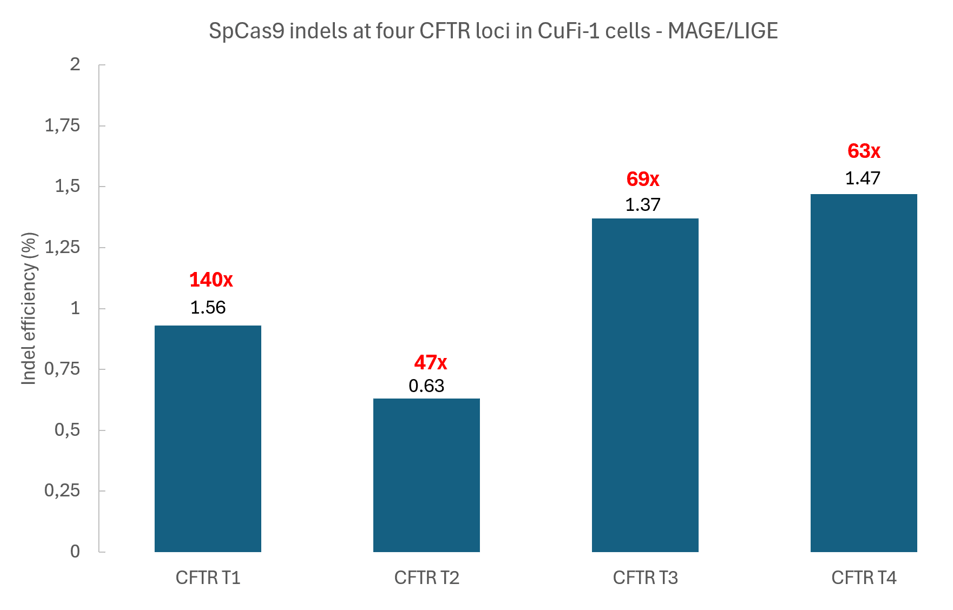
Figure 8. Magnetofection enables editing in a hard-to-transfect disease model. SpCas9 indel frequencies at four CFTR loci (T1 to T4) in CuFi-1 cystic fibrosis cells, delivered by lipofection or magnetofection. Lipofection was essentially inactive, whereas magnetofection produced measurable editing at every site, corresponding to 47- to 140-fold gains (fold gain = magnetofection / lipofection). Mean of three independent biological replicates.
Practical advantages
- Hardware-free: PolyMag Neo & a magnetic plate (Super or Mega magnetic plate), with no other equipment to buy or maintain opposed to electroporation instruments.
- Gentle: high efficiency without the toxicity of lipofection or other physical methods.
- Economical: strong performance at low material input (cargo & reagent).
- Versatile: one workflow spans plasmid DNA, prime editing components and preassembled RNP.
- Simple: a short magnetic incubation slots directly into standard cell culture.
Conclusion
Across Cas9, Cas12, prime editing and RNP, PolyMag Neo magnetofection delivered 3.4- to 8.3 fold higher editing efficiency than Lipofectamine 3000, reproducibly and without compromising fidelity or viability. By targeting the true rate-limiting step, intracellular delivery, it converts difficult, low-yield edits into robust, routine results. PolyMag Neo stands out as a simple, safe and broadly applicable delivery platform for next generation genome engineering.
Read the paper Access PolyMag Neo
Related Articles
CRISPR-based functional genomics in primary acute myeloid leukemia samples
Uukuniemi virus infection remodels the RNA-binding proteome in tick cells