


BLOG > mRNA & LNP > Stem cell mRNA transfection: LNP delivery Application Note
Efficient mRNA delivery to primary human stem cells: overcoming transfection challenges in difficult-to-transfect cell types
Stem cells are among the most challenging cell types to transfect using conventional approaches, due to their unique biological properties and their sensitivity to cytotoxic stress. Lipid Nanoparticles (LNPs) represent the most effective and safe delivery systems for nucleic acid delivery. However, delivering mRNA to multipotent and pluripotent stem cells requires formulations specifically engineered to address their distinct biological barriers.
We developed NanOZ-LNP Stem, a proprietary lipid formulation optimized for stem cell transfection. The formulation protects mRNA from degradation and facilitates intracellular uptake while maintaining cell viability and phenotypic integrity. Our delivery systems are produced through microfluidic technology, resulting in monodisperse NanOZ LNP-mRNA with narrow size distribution and high encapsulation efficiency (>80%).
Primary human stem cell transfection efficiency
To evaluate NanOZ-LNP Stem performance, primary human stem cells were transfected in 96-well plates with 0.1, 0.5, and 1.0 µg of mRNA GFP encapsulated in LNP Stem formulation (0.1 mg/mL mRNA in LNPs in PBS with 10% sucrose) or in LNPs formulated with SM-102. 24h later, the percentage of GFP+ cells and fluorescence intensity were monitored by flow cytometry.
Results demonstrate the capacity of LNP Stem to efficiently transfect primary human CD34+ stem cells, outperforming the SM-102 control across all doses tested (Figure 1).
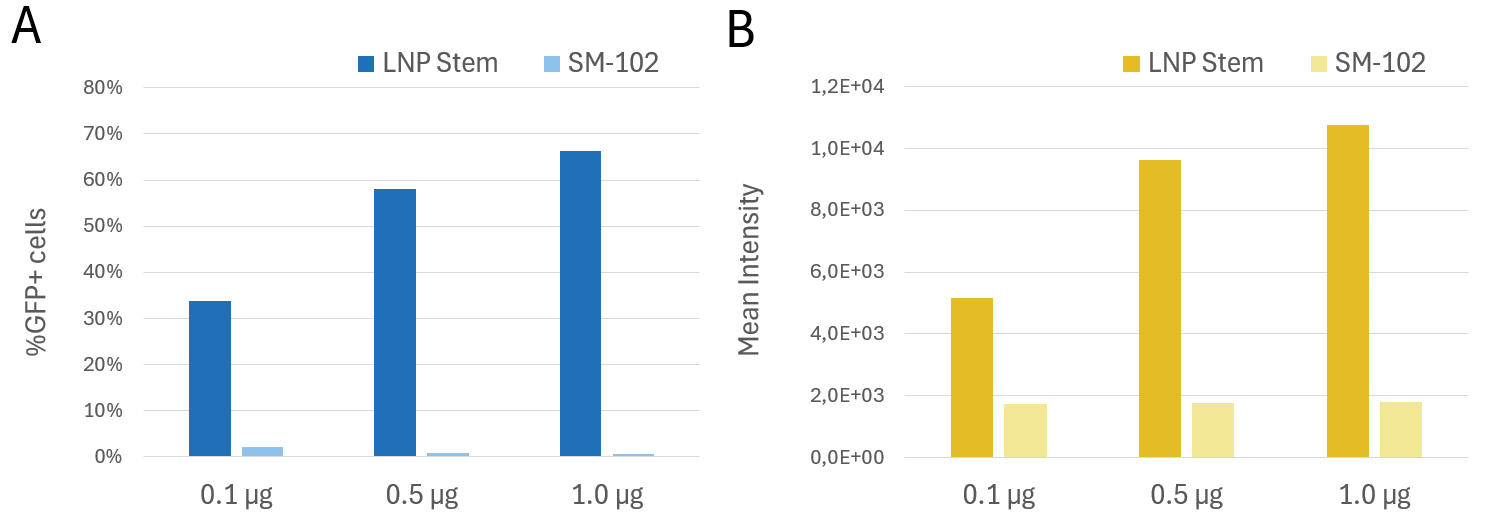
Figure 1:Transfection of primary human CD34+ cells: % GFP+ cells (A) and fluorescence intensity (B) were measured 24H after transfection with LNP Stem or LNP SM-102.
Cell viability and phenotype preservation
A critical advantage of NanOZ-LNP Stem is its minimal impact on cell health. Following transfection with 0.1, 0.5, and 1.0 µg mRNA GFP under identical conditions, viability was determined 24h later using fixable viability dye eFluor 780.
LNP Stem formulation is totally non-toxic for the cells and preserves cellular phenotype (Figure 2)
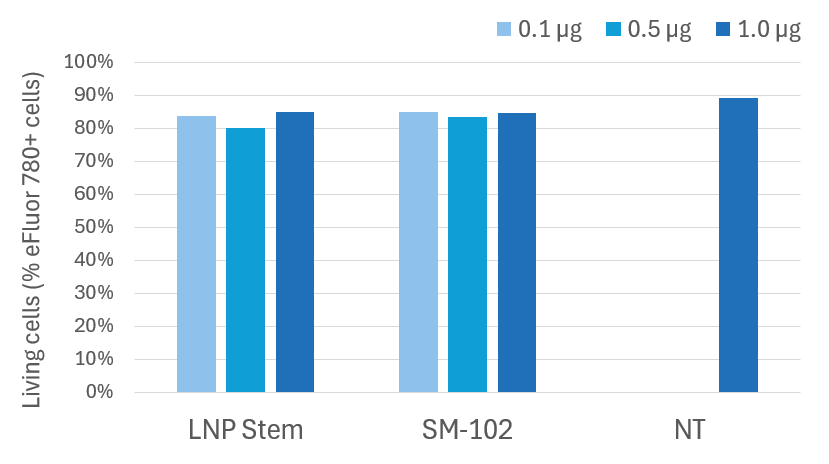
Figure 2:Viability measurement after transfection. Viability was measured in primary human stem cells 24H after transfection with mRNA-GFP encapsulated in LNP Stem or in SM-102 LNP and compared to non-transfected (NT) cells.
To further assess phenotype preservation, primary human stem cells were transfected with 0.1, 0.5, and 1.0 µg of GFP mRNA encapsulated in LNP Stem or SM-102 formulations. 24h later, cells were stained with an anti-CD34 PE antibody to evaluate stem cell phenotype preservation at the cell surface. CD34 expression data demonstrate that LNP Stem formulation not only is non-toxic but also preserves stem cell phenotype, maintaining CD34+ status compared to SM-102-treated cells (Figure 3).
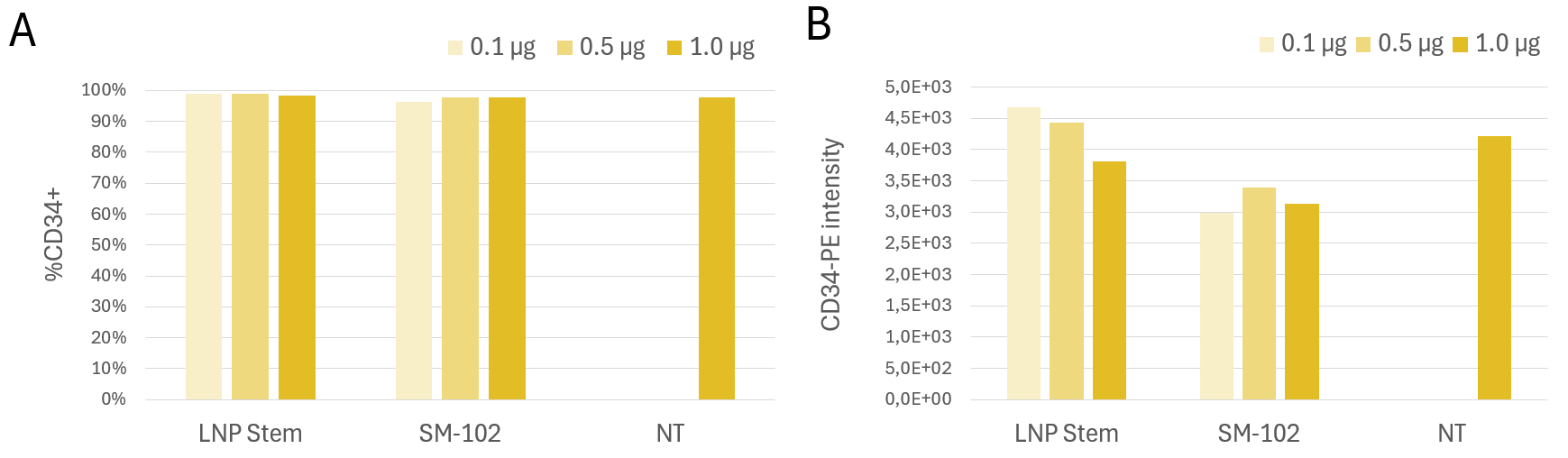
Figure 3:CD34 expression at the cell surface after transfection. % CD34+ cells (A) and PE intensity (B) were measured 24H after transfection with LNP Stem or LNP SM-102.
Compatibility with stem cell lines
NanOZ-LNP Stem formulation is compatible for primary as well as CD34+ cell lines. The CD34+ stem cell line KG1a was transfected in 24-well plates with ranging doses of mRNA GFP encapsulated in LNP Stem formulation (0.1 mg/mL mRNA) or in LNPs formulated with SM-102. 24h later, transfection efficiency was determined by fluorescence microscopy and flow cytometry. These results demonstrate high transfection efficiency across the dose range tested in cell line models (Figure 4).
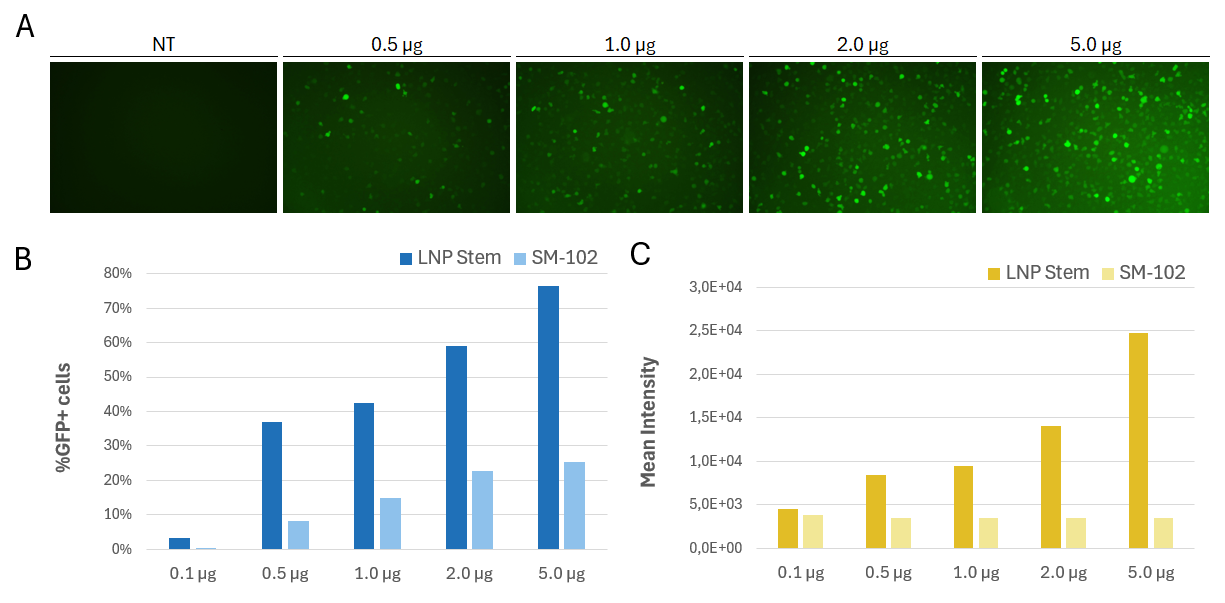
Figure 4:Transfection efficiency in KG1a cell line: LNP Stem efficiency was monitored by fluorescence microscopy (A) and % GFP+ cells (B) and GFP intensity (C) compared to SM-102 at 24H by flow cytometry.
NanOZ-LNP Stem delivers high transfection efficiency across a wide range of stem cells from cell lines to primary stem cells, while maintaining cell viability and phenotypic integrity. The ready-to-use formulation requires no specific transfection buffer, streamlining your stem cell transfection workflows.
Related Articles
White paper: Ionizable lipids for mRNA-LNP and siRNA-LNP delivery
New high-expression Cytokine mRNAs for research