

FAQ & Transfection Tips > Lipid Nanoparticles
Composition & Structure
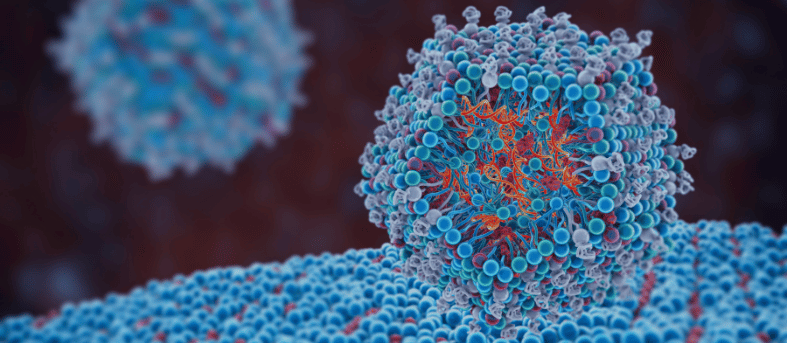
Our catalog LNP formulations are based on proprietary ionizable lipid developed in-house, combined with DSPC, cholesterol, and DMG-PEG2000, in a molar ratio of 50:10:38.5:1.5. Each lipid component plays a specific role in the overall performance of the formulation:
- Ionizable lipid (complexing lipid): enables nucleic acid complexation, promotes membrane fusion and facilitates endosomal escape for efficient intracellular delivery.
- Helper lipid (DSPC): contributes to particle stability and structural integrity.
- Cholesterol: also contributes to particle stability and structural integrity.
- PEG-lipid (DMG-PEG2000): provides a stealth effect, reducing immune recognition and extending blood circulation time in vivo.
Our NanOZ LNPs are produced using a jet-mixing method, which enables precise and reproducible nanoparticle formation. This process involves mixing the nucleic acid cargo dissolved in an aqueous buffer with the lipid components dissolved in ethanol, under precisely controlled flow conditions. This approach ensures:
- High reproducibility between batches.
- Precise control over particle size and composition.
- High encapsulation efficiency, consistently exceeding 80%.
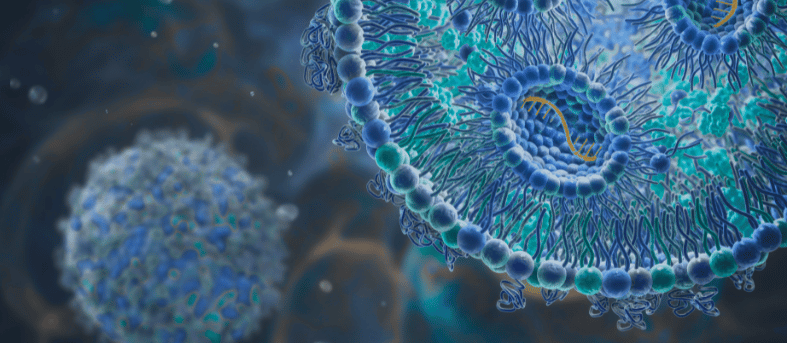
When loaded with an RNA cargo, the nucleic acid is organized within inverse lipid micelles inside the nanoparticle core, while empty LNPs are structured as lipid vesicles. This architecture is key to protecting the nucleic acid from degradation and ensuring efficient intracellular release upon endosomal escape.
We use our own proprietary ionizable lipids, developed and optimized at OZ Biosciences.
For custom orders, alternative proprietary or commercial ionizable lipids as well as entirely different LNP compositions can be done upon request. Please contact us to discuss your specific formulation needs.
Our catalog LNP formulations are available with mRNA and siRNA as nucleic acid cargos.
For more specific requirements, our custom LNP formulation service supports encapsulation of a broad range of cargos. Please fill in our dedicated custom LNP formulation quote form or contact us to discuss the feasibility of your specific cargo.
Yes. We have developed a dedicated range of fluorescently labeled LNPs, called NanOZ Fluo LNPs, by incorporating lipophilic dyes directly into their lipid structure. These ready-to-use formulations enable effective monitoring of cellular internalization, intracellular trafficking, and in vivo biodistribution. Our NanOZ Fluo LNP range is available in several labeling options to suit your experimental needs:
- NanOZ Fluo LNP-DiR: contains a lipophilic carbocyanine dye DiR having an excitation max. at 748 nm, and emission max. at 780 nm.
- NanOZ Fluo LNP-DiO: contains a lipophilic carbocyanine dye DiO having an excitation max. at 487 nm, and emission max. at 501 nm.
- NanOZ Fluo LNP-DiI: contains a lipophilic carbocyanine dye DiI having an excitation max. at 549 nm, and emission max. at 565 nm.
- NanOZ Dual Fluo LNP (DiOCy5-mRNAFLuc): dual-labeled with DiO (DiOC18) and Cy5-mRNA FLuc.
Storage & Stability
Our LNP formulations should be stored at -80°C for long-term storage up to 6 months. Once thawed, products can be kept at 4°C for up to two weeks. Based on our experience, one freeze-thaw cycle can be performed without significant impact on product quality. To preserve particle integrity and activity, we recommend avoiding repeated freeze-thaw cycles and instead aliquoting the LNP working on ice during handling.
Our LNP products are formulated in PBS supplemented with 10% sucrose at pH 7.2, which is suitable for in vivo administration.
Quality Control
Each LNP batch undergoes a comprehensive quality control workflow including particle size and PDI measurement by DLS, zeta potential analysis, encapsulation efficiency determination by fluorescent assay, and mRNA concentration measurement. The sterility is also assessed by incubating the LNPs in culture medium for 14 days. For superior grade products, endotoxin testing and cholesterol content quantification are additionally performed.
We determine encapsulation efficiency using a fluorescent assay, which allows quantification of both total and unencapsulated nucleic acid. mRNA concentration is measured using a plate-reader spectrophotometer in combination with a fluorescent assay to ensure accurate quantification of the encapsulated cargo.
Our LNPs are purified by dialysis. This process ensures the complete removal of all formulation solvents and replace it by our storage buffer. A cryoprotectant is also added and the product is concentrated if necessary to the desired final concentration.
Following purification, our LNPs are sterilized by filtration through a 0.2 µm membrane filter, ensuring product safety and compatibility with in vivo administration.
Our LNP are formulated with an average diameter of 100 ± 50 nm and the PDI must be kept under 0.2 to be validated by our quality control tests.
Applications
Yes. Our NanOZ LNP-mRNA and LNP-siRNA formulations are suitable for in vivo use and have been validated for multiple routes of administration, including intramuscular (IM), intravenous (IV), intraperitoneal (IP), and subcutaneous (SC) injections. Supporting data is available upon request.
While our LNPs are not specifically designed to act as immune stimulants, emerging studies suggest that LNP components themselves may exhibit inherent immunogenic properties in certain contexts. This is an active area of research, and the extent of immune activation will depend on the LNP composition, the nucleic acid cargo, and the biological system used. We recommend consulting the relevant literature and conducting appropriate controls in your experimental setup.
Unlike transfection reagents, LNPs are not designed to spontaneously complex with nucleic acids after formation. RNA or DNA must be encapsulated during the manufacturing process using dedicated equipment. Simply mixing mRNA with empty LNPs will not result in efficient encapsulation or functional delivery. If you wish to have your mRNA of interest encapsulated in our LNP system, we offer a dedicated custom LNP formulation service.
Samples are not available for our LNP products. However, if you are unsure which formulation will perform best in your experimental model, we offer our LNP Selection Kit, allowing you to test 3 or 5 different formulations and select the one that best suits your specific needs. As LNP properties directly influence diffusion efficiency, stability, and biodistribution, each research model may require its own optimized formulation depending on the nucleic acid cargo, the route of administration, and the target cell type, tissue, or organ.
For any specific requirements or questions, feel free to contact us to discuss your needs.
Custom LNP service
You can request a quote by filling in our dedicated form for custom LNP formulation available here. If you need further guidance or wish to discuss your project and specific requirements with our technical team, feel free to contact us, we will be happy to arrange a meeting at your convenience.
Once the mRNA or nucleic acid cargo is ready, our LNP production process typically takes 2 to 3 weeks: approximately one week for production and one week for quality control. If custom mRNA synthesis is also required, please allow an additional 8 weeks for mRNA production prior to LNP formulation.
The minimum order quantity for our custom LNP formulation service is 0.5 mL. For specific requirements outside this range, please contact us to discuss available options.
Our custom LNP formulation service supports encapsulation of a wide range of molecules, including mRNA, siRNA, saRNA, DNA, ASO/ODN, and other molecules of interest. Regarding the origin of the cargo, we offer three options:
- OZB catalog mRNA: choose from our existing catalog of ready-to-use mRNAs (e.g. eGFP, Luciferase, OVA, Spike)
- OZB custom mRNA: we produce a custom mRNA from your sequence of interest
- Customer-supplied molecule: you provide your own molecule, which we will encapsulate into our LNP system
Simply indicate your preferences when filling in our dedicated custom LNP formulation quote form and our team will get back to you with a tailored proposal.
Yes. As part of our custom service, we can work with alternative ionizable lipids or entirely different LNP compositions to meet your specific delivery requirements; whether for targeted delivery, specialized routes of administration, or unique cargo types. If you are able to provide your own lipids, we can incorporate them into our formulation process. Simply specify this when filling in our custom LNP formulation quote form and we will proceed accordingly.
Yes, the final concentration can be modulated upon request. However, achievable concentrations may vary depending on the nature and amount of the encapsulated molecule. Please specify your concentration requirements when submitting your order or quote request.
Yes. As an option, our LNPs can be functionalized with targeting ligands such as peptides or antibodies, enabling active targeting strategies for specific cell types or tissues. Visit our targeted LNP formulation page to learn more about the available conjugation strategies, or fill in our quote request form directly, specifying your targeting requirements in the dedicated section.
Explore our other FAQs

RNA

TRANSFECTION
VIRAL APPLICATIONS
IN VIVO DELIVERY
PROTEIN DELIVERY
ASSAYS KITS & TRANSFECTION TOOLS
STEM CELL APPLICATIONS